
Christmas Activities for Neurodivergent and Disabled Learners
Throughout December, we work on small holiday-themed projects to connect with and reinforce the skills my son has been building since September.
Repeating activities across different formats, in different contexts, and over time allows him to truly internalize new skills in a way that feels both predictable and meaningful.

Crafts on a table as part of 10 adapted Christmas activities.
This post highlights the activities we explore, the learning goals behind them, and the adaptations that help make each experience accessible for neurodivergent learners. Many of these projects also serve as reusable props throughout the month (e.g., puppets, masks, and visual supports) that my son helps design, so the materials are familiar and connected to his learning.
For example, when we work on the Santa mask, we repeat the word and ASL sign for beard so often that when I say, “Show me beard,” he taps the right spot on the mask. That’s the magic of repetition, familiarity, and hands-on involvement.
Note: Choose a few activities that match the child’s developmental level, adapt them as needed, and use those same creations in many different ways (e.g., storytelling, sensory play, movement games, puppet shows).
Using concrete, practical, and visual materials over time helps the child internalize skills in many contexts.
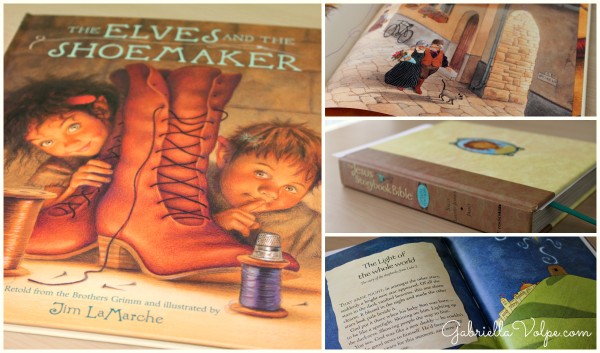
Holiday books as part of 10 adapted Christmas activities.
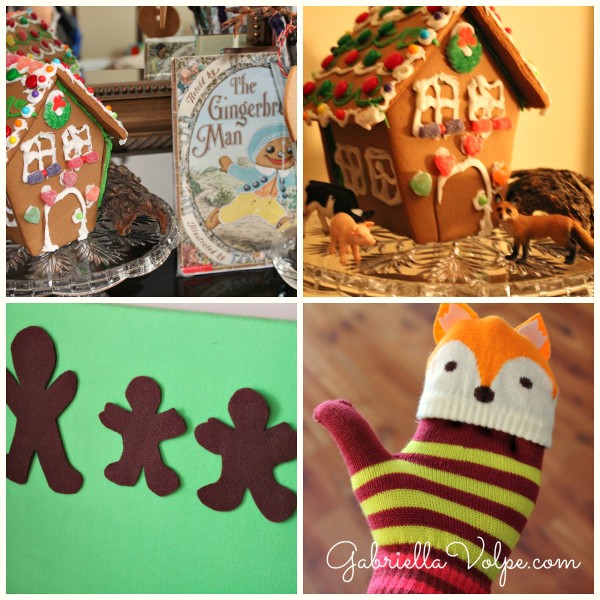
The story of The Gingerbread Man, retold by Jim Aylesworth with props (Can you find the cow, the pig and the fox?) The fox mitten was fun for switching up the story and swallowing up the gingerbread man in a very obvious way.
1. Gathering Holiday Books
Activity
We ease into December with a small set of intentional, repeated read-alouds. Instead of rotating through a huge basket of books, we choose two or three that become part of our daily rhythm:
- The Elves and the Shoemaker (Jim LaMarche) – morning story
- The Jesus Storybook Bible (Sally Lloyd-Jones) – short nightly reading by candlelight
- The Gingerbread Man (Jim Aylesworth) – our end-of-month focus
Reading the same stories daily builds anticipation, pattern recognition, and the comfort of knowing what comes next.
Learning Goals
- Language development: story patterns, simple rhyme, symbolic play
- Receptive language: vocabulary + ASL signs (elf, elves, shoes, Baby Jesus, Mary, Joseph, donkey, gingerbread man, run, catch, little old lady, little old man, fox)
Adaptations
- Turn off competing sounds (TV, radio, appliances) and lower lighting if needed for regulation.
- Use a predictable transition cue, such as a short “Story Time” song
- Offer two book choices using real objects or covers, not just spoken choices.
- Tell the story rather than reading word-for-word to maintain a connection.
- Shorten or skip sections if attention wanes.
- Use figurines, props, or laminated story cards to act out the parts.
- Repeat the same book daily so the structure becomes predictable.
- Provide something to hold or fidget with while listening.
- Pair words with gestures, ASL, or AAC.
- Sit side-by-side rather than face-to-face if eye contact is hard.
- Keep the stories in a visible “story basket” to support anticipation.
- Pause and let your child fill in repeated phrases however they can (gesture, sign, AAC button, etc.).
Related Articles
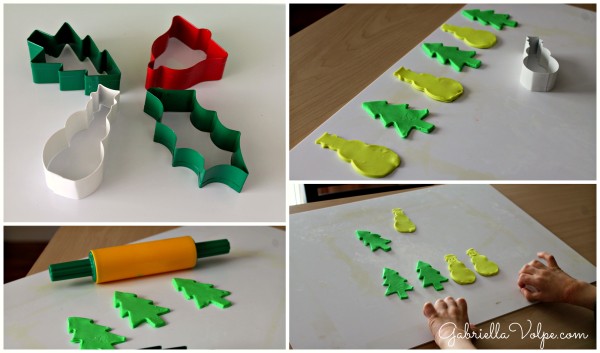
My son giggles at the pattern in the song, but the real highlight is flipping the board beneath the playdough, which is far more exciting than any cookie-cutter snowman.
2. Playdough and Cookie Cutters
Activity
We explore clay with cookie cutters and a little song:
One little, two little, three little Christmas trees
One little, two little, three little Christmas trees,
One little, two little, three little Christmas trees,
Hey-ho, Christmas time is here!
(Repeat with snowman, etc.)
Learning Goals
- Fine motor: rolling, pounding, pressing
- Pattern awareness: “tree, snowman, tree…” and color patterns
- Sensory exposure: touching clay without discomfort
Adaptations
- Model using hand-under-hand (support without forcing, and always with consent).
- Offer a choice between tools (roller, cutter, plastic knife).
- Provide multiple textures (soft dough and firmer dough) to gradually broaden tolerance.
- Keep a damp cloth nearby so hands can be wiped quickly if needed.
- Present the dough in smaller portions to reduce overwhelm.
- Offer movement breaks if in-hand pressure becomes tiring.
- Model a simple pattern visually rather than expecting imitation.
- Allow alternative engagement (squeezing dough, poking holes) instead of insisting on cutting shapes.
- Keep the session short and end on a success.
Related Articles
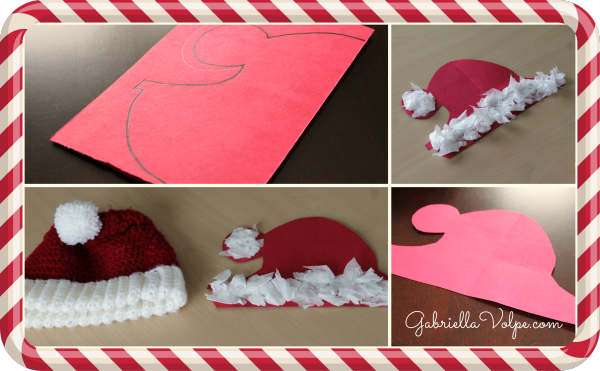
A Santa hat craft as part of 10 adapted Christmas activities.
3. Creating a Santa Hat
Activity
I prep a hat shape in advance. Since I wear a Santa hat throughout December, he’s already familiar with its parts.
Learning Goals
- Fine motor: glue (“zoom-zoom”), rip tissue paper, push with pointer finger, tap into place
- Sensory exposure: crinkly tissue paper
- Receptive language: red, white, pom-pom, Santa, hat (ASL and/or AAC supported)
Adaptations
- Repeat short phrases (“rip, push, tap-tap”) as a predictable verbal routine.
- Pre-cut shapes so the task focuses on participation, not precision.
- Provide a visual sequence card (1: glue, 2: rip, 3: push, 4: tap).
- Keep tissue paper in a shallow tray to prevent scattering.
- Use thicker paper if thin paper tears too easily and causes frustration.
- Offer different textures (felt, construction paper, foam) for sensory choice.
- Use glue sticks instead of liquid glue if “zoom-zoom” is overwhelming.
- Allow participation at any level: watching, touching materials, or placing one piece only.
- Narrate steps using short, predictable language (“rip…push…tap”).
- Give a clean finger for modeling if glue on the hands is uncomfortable.
Related Articles
12 Days of Discovery
To celebrate the season and help you finish the year with curiosity, connection, and a bit of fun, here’s a FREE tool designed to spark creativity and joy in your family’s learning.
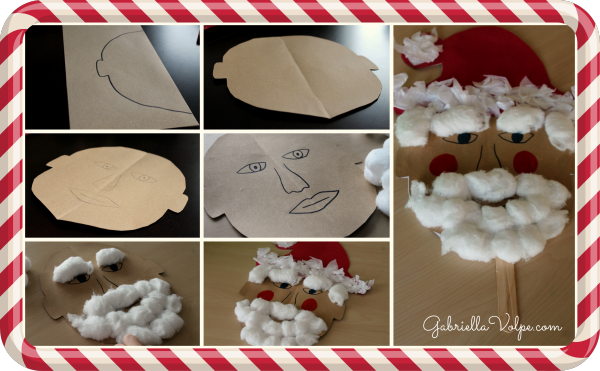
A Santa mask craft as part of 10 adapted Christmas activities.
4. Creating a Santa Mask
Activity
We expand the hat into a full Santa face. We sing “Must Be Santa” as we work.
Who’s got a beard that’s long and white?
Santa’s got a beard that’s long and white.
Who comes around on a special night?
Santa comes around on a special night.
Beard that’s white.
Special night.
Must be Santa, must be Santa, must be Santa,
Santa Claus!
Learning Goals
- Fine motor: gluing, tapping cotton
- Sensory: soft cotton texture
- Receptive language: Santa, face, eyes, nose, ears, beard, ho-ho-ho (with ASL or AAC)
Adaptations
- Demonstrate labeling on your own face before pointing to the mask.
- Provide a mirror so the child can see themselves while learning features.
- Let them explore cotton with a tool (e.g., a spoon or paintbrush) before touching it with their hands.
- Offer unscented or low-odor glue if sensitive to smells.
- Use a tray or mat to clearly define the workspace.
- Present cotton in small amounts to reduce sensory overload.
- Use a “first–then” visual to support transitions (“First glue beard, then song”).
- Invite participation using options (“Glue beard or glue hat?”)
- Give a longer processing time after each verbal cue.
Related Article
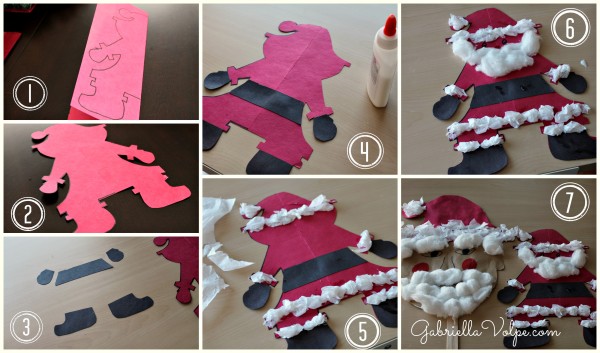
Our large mask helps us label facial features, while the mini-Santa puppet helps us explore body parts. The word ‘pom-pom’ brings instant giggles every time.
5. Making a Full-Body Santa Puppet
Activity
We create a full Santa to explore body parts in a playful, holiday-themed way.
Learning Goals
- Fine motor: glue, tap, place cotton and tissue
- Sensory: cotton and tissue paper
- Receptive language: Santa, belt, mittens, boots, face, beard, arms, legs, hands, feet (ASL and/or AAC supported)
How to make this Santa
Note: I designed this freehand, but used some Santa images for inspiration. Look through books and magazines for ideas (or just use this as a model). It’s sometimes easier to freestyle than to spend hours on Pinterest searching for the right printable image. You can do it, too!
1. Fold paper; trace the outline of one side of Santa’s body on red construction paper.
2. Cut and open. Cut off the extra part of his hat (since you’ll get two pom-poms).
3. Using black construction paper, trace the little hands and feet and design a belt. Then, cut.
4. Glue black accessories. Tap into place – open palm.
5. Rip white tissue paper, tuft (using pointer finger), and glue into place.
6. Draw eyes, nose and mouth (it gets covered up, but I talked about it as I drew it).
7. Using cotton, add facial hair.
Adaptations
- Pre-assemble some parts if multi-step projects cause fatigue.
- Provide a labeled visual outline of body parts as a reference.
- Offer choices for textures (cotton, felt, tissue paper, wool).
- Break the project across multiple days if needed.
- Use adaptive scissors or tear strips for cutting alternatives.
- Use double-sided tape if glue textures are too overwhelming.
- Allow the child to focus on a preferred part (e.g., only the pom-pom).
- Keep extra parts available in case one gets damaged or becomes overstimulating.
- Model body part signs or gestures to reinforce vocabulary in context.
Related Articles
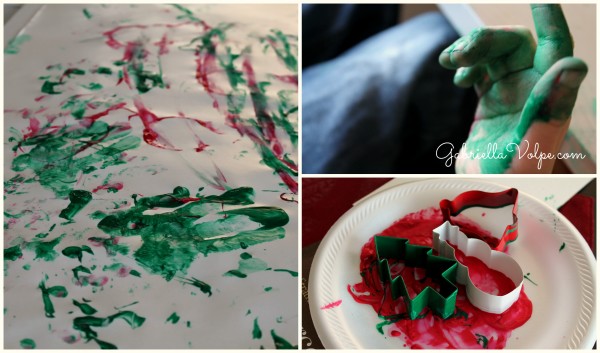
A breakthrough moment: my son dips his whole hand into the paint tray, giggles at the sensation, and proudly opens and closes his paint-covered hand. Painting with cookie cutters as part of 10 adapted Christmas activities.
6. Printing with Cookie Cutters
Activity
What looks like a messy paint session is actually a celebration of sensory bravery and exploration.
Learning Goals
- Fine motor: grasping cutters, pressing onto paper
- Sensory exploration: fingerpainting
- Receptive language: red, green (with ASL and/or AAC)
Adaptations
- Start with dry stamping before adding paint.
- Provide paint in very shallow trays to avoid deep sensory immersion (unless desired).
- Allow use of gloves or a brush as a bridge to bare-hand exploration.
- Offer warm water nearby for immediate cleanup if needed.
- Tape the paper securely to support stability and reduce movement.
- Use a non-slip mat under the tray for easier reach.
- Present only one color at a time to avoid visual overload.
- Encourage sensory exploration only if the child initiates (never forced).
- Keep towels and wipes within reach to support autonomy.
Related Article
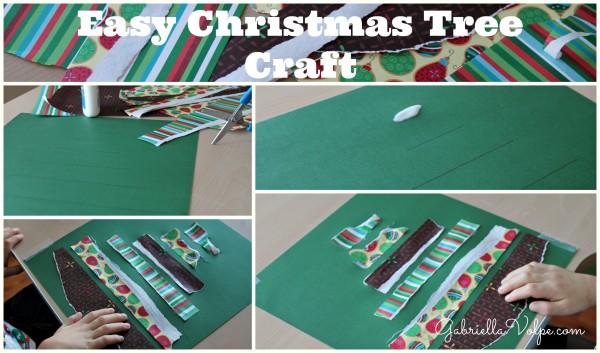
Christmas tree with scrapbooking paper as part of 10 adapted Christmas activities.
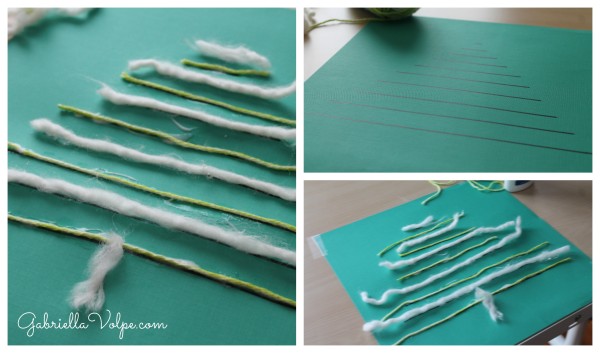
Martha’s inspirational project is similar to this yarn project. We used large scrapbooking paper for the background and longer pieces of yarn to make it easier to manipulate.
7. Scrappin’ Tree (Yarn or Paper Tree Art)
Activity
Inspired by Martha Stewart (because yes, even high-gloss craft ideas can be adapted), we make a textured tree using yarn or paper.
Song
O Christmas Tree, O Christmas tree,
How lovely are your branches!
O Christmas Tree, O Christmas tree,
How lovely are your branches!
Not only green in summer’s heat,
But also winter’s snow and sleet.
O Christmas tree, O Christmas tree,
How lovely are your branches!
Learning Goals
- Fine motor: cutting yarn, gluing, placing pieces
- Receptive language: Christmas tree (with ASL and/or AAC)
Adaptations
- Give pre-cut yarn or larger strips for children who struggle with scissors.
- Offer thicker yarn or ribbon if the thin string is hard to grasp.
- Provide glue dots as an alternative to wet glue.
- Use a weighted paper base to prevent tearing during placement.
- Offer sensory supports like a firm board under the paper for stability.
- Present one step at a time using a visual sequence.
- Allow the child to explore materials first before placing them.
- Give choices (“Yarn or paper today?”).
- Use AAC or gesture prompts to support decision-making.
Related Articles
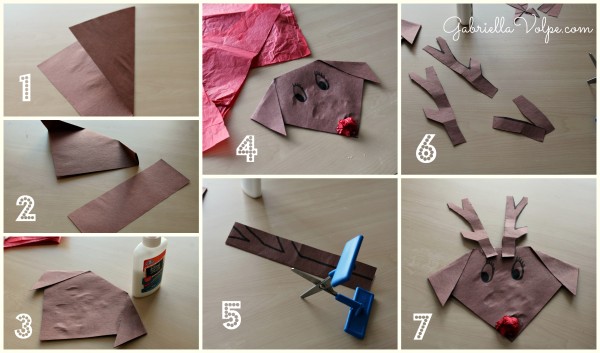
A Rudolph puppet as part of 10 adapted Christmas activities.
8. Creating a Rudolph Puppet
Activity
A single sheet of construction paper becomes a simple Rudolph face.
Learning Goals
- Fine motor: glue, scrunch tissue, tap into place
- Sensory: tissue sound and texture
- Receptive language: reindeer, Rudolph, ears, eyes, nose (ASL and/or AAC supported)
How to make Rudolph’s face
- Fold a regular-sized construction paper to form a triangle.
- Trim off the bottom (keep for step 5). Fold over two flaps for ears.
- Glue the ears and the double flap of the face. Hold in place – palms open until set.
- Draw eyes (I drew them in – but your child might be able to do it on his own) and scrunch up red tissue paper for the nose. Glue and hold.
- Fold the rectangular piece left over from step 2, lengthwise. Draw an antler outline. (I did this freehand… no special design needed). Then, cut, cut, cut along the dark line.
- Open the fold and cut down the middle to get two antlers. Trim off a little on the bottom (otherwise, the antlers will be too long and will flop over on Rudy’s head).
- Glue and hold antlers into place – palms open.
Optional: Glue onto a craft stick to make a puppet.
Adaptations
- Fold and pre-crease the paper so the child only has to press.
- Offer a large, simple version of the Rudolph face if fine details are too small.
- Provide different nose options (pom-pom, tissue, sticker).
- Use high-contrast colors to make features easier to place.
- Offer a thick glue stick for easier control.
- Allow participation in one small part only (e.g., gluing ears) and model the rest.
- Use a finger spacer or guide for gluing to avoid sticky hands.
- Let the child observe first if participation feels stressful.
Related Articles
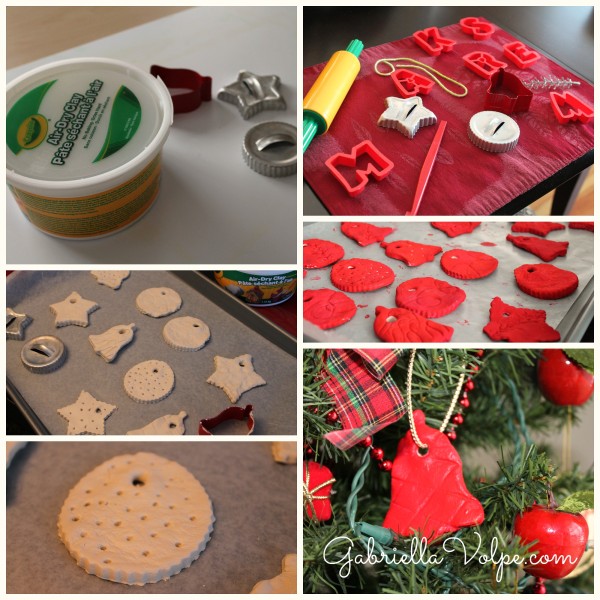
Clay ornaments are part of 10 adapted Christmas activities. We used Crayola’s air-dry clay, cookie cutters, and playdough accessories to make these ornaments. It took about a week from start to finish, as each step requires some drying time. After cutting and pressing the ornaments, we painted them with tempera paint using a sponge roller, then I used Mod Podge to add a final sheen. The inspiration for this project came from Reading Confetti blog.
9. Making Air-Dry Clay Ornaments
Activity
We shape and paint simple air-dry clay ornaments to give as gifts.
Learning Goals
- Fine motor: rolling, pressing, cutting clay
- sensory: clay-handling without discomfort
- Receptive language: bell, circle, star, ornament (ASL)
Adaptations
- Warm the clay slightly to make it easier to manipulate.
- Offer rolling pins of varying weights to accommodate sensory preferences.
- Use cookie cutters with larger handles for better grip.
- Provide gloves if bare-hand texture is challenging.
- Use a silicone mat so the clay doesn’t stick.
- Break the activity into two sessions: shaping one day, painting another.
- Offer choices of clay tools to improve engagement.
- Encourage any level of interaction (touching briefly, pressing once, watching).
Related articles
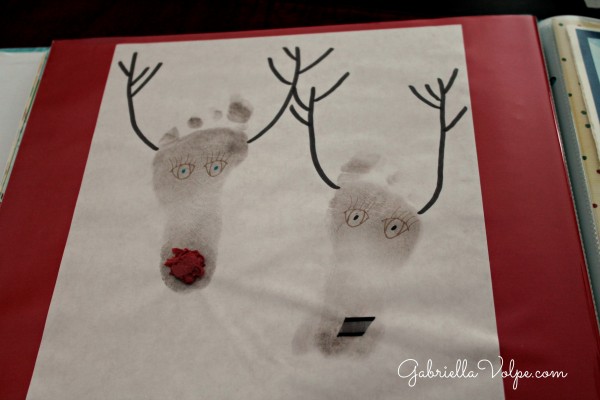
Rudolph footprint craft puppet as part of 10 adapted Christmas activities. This project sits in a scrapbook album, which is a nice bonus when using scrapbook paper as a background. Just slip it into the yearbook and done!
10. Rudolph Footprint Art
Activity
This project (made in earlier years) remains a sweet keepsake and a fun sensory experience.
Learning Goals
- Fine motor: scrunching tissue
- Sensory: paint on bare feet
- Receptive language: Rudolph, reindeer, eyes, nose (ASL and/or AAC)
Adaptations
- Use warm paint instead of cold to reduce sensory shock.
- Offer a dry-run practice (foot on clean paper) before adding paint.
- Let the child wipe their own feet afterward for autonomy.
- Provide towels, wipes, and a wash basin nearby.
- Offer a firm hand or a stable piece of furniture for balance support.
- Keep the paint very thin and spread it evenly to avoid a slippery surface.
- Consider using a textured mat underneath to support grounding.
- Allow the child to observe or direct you verbally/AAC if they prefer not to participate physically.
Get more resources like this one
Sign-up to my newsletter and I’ll send you email updates regarding education, accessibility, and disability justice.

By signing up for email alerts, you agree to receive updates and promotions from me. You can unsubscribe at any time.
What great projects!
Thank you for the detailed instructions and adaptations!
I’d love to know if you try any – even if next year!